



Why First-Time Bay Area Buyers Should Seriously Consider a Multifamily Property (Yes, Even in Oakland and the East Bay)
If you've spent any time house-hunting in the Bay Area as a first-time buyer, you already know the math doesn't feel like it's on your side. As of today, August 18th, we're heading into the fall market, and good Oakland inventory is starting around $850,000 and climbing from there — in Berkeley, it's tough to get into a single-family home in a neighborhood you actually want to live in for under $1.4 million. Either way, buying solo can mean a mortgage payment that eats half your take-home pay.
There's a strategy I bring up constantly with first-time buyers, especially here in the East Bay, and it doesn't get nearly enough attention outside of real estate investor circles: buy a small multifamily property — a duplex, triplex, or fourplex — live in one unit, and rent out the others. It's often called "house hacking," and in a market as expensive as ours, it can be the single most effective owner-occupied multifamily investing strategy for getting into homeownership without white-knuckling every mortgage payment. Done right, it's forced savings, cash flow relief, and long-term wealth-building rolled into one first-time homebuyer strategy.
Let me walk you through why this makes sense right now, what's actually changed to make it easier, and the East Bay-specific details you need to know before you go this route.
The core idea: let your tenants pay down your mortgage
The concept is simple. Instead of buying a single-family home and covering 100% of the mortgage, taxes, and insurance yourself, you buy a 2-4 unit property, occupy one unit, and rent out the rest. The rental income from your tenants offsets — sometimes substantially — your monthly housing cost.
In a market where the median single-family home eats an enormous share of a typical income, this changes the equation. Instead of asking "can I afford this entire mortgage on my own?" you're asking "can I afford the gap between my mortgage and what my tenants will pay me?" That gap is almost always a much smaller, much more manageable number.
Flip that around and there's another way to look at it: house hacking often lets you afford more home than you could as a solo buyer — more bedrooms, more square footage, a better commute, a neighborhood that would otherwise be out of reach — because your tenants are subsidizing a real chunk of the mortgage every month. A lot of first-time buyers assume multifamily means "settling." In practice, it's frequently the opposite. It's how you land a bigger, better property for a lower effective monthly cost than a comparable single-family home would ever pencil out to.
Financing has actually gotten easier — this is the part most buyers don't know
This is the piece of information I most want first-time buyers to hear, because it's changed significantly and a lot of people are still operating on outdated assumptions.
Conventional financing now allows just 5% down on owner-occupied 2-4 unit properties. Fannie Mae rolled this out starting in late 2025, a major drop from the 15-25% down payments multifamily buyers used to need. On top of that, the FHA "self-sufficiency test" — a rule that used to require the rental income on 3- and 4-unit properties to essentially cover the whole mortgage before you could even qualify — no longer applies to these conventional loans. That test used to disqualify a lot of otherwise-qualified buyers. It's a much friendlier lending environment for owner-occupant multifamily buyers than it was even two years ago.
FHA remains a strong option too, with the usual 3.5% down payment for owner-occupants, and FHA loan limits in Alameda County for 2026 are generous enough to make it realistic here:
- 1-unit: up to $1,249,125 (high-balance) / $832,750 (standard)
- 2-unit: up to $1,599,375
- 3-unit: up to $1,933,200
- 4-unit: up to $2,402,625
Those limits mean you can finance a legitimate East Bay duplex or triplex through FHA without needing jumbo financing. Combine that with a 30-year fixed rate currently sitting around 6.6%, and a well-underwritten multifamily purchase can pencil out in a way that surprises a lot of first-time buyers who assumed multifamily was only for seasoned investors with big down payments.
What the numbers might actually look like
Every deal is different, but here's an illustrative example to make this concrete. Say you find an Oakland duplex — maybe in North Oakland or the Laurel district — listed around $950,000. With 5% down on a conventional owner-occupant loan, you're putting down roughly $47,500 plus closing costs, instead of the $190,000+ a 20% down payment would require on a comparable single-family home.
If the second unit rents for $2,400-$2,800 a month (a realistic range for a one or two-bedroom in many Oakland neighborhoods), that rental income is going straight against your mortgage, taxes, and insurance every single month. Depending on your loan terms, that can shrink your effective monthly housing cost by a third or more compared to carrying the same size mortgage entirely on your own.
That's not "free money" — you're still responsible for the full mortgage, maintenance on both units, and being a landlord. But it's a fundamentally different risk profile than shouldering an entire Bay Area mortgage solo on a starter income.
The rewards multifamily gives you that a single-family home doesn't
Before we get into the more complicated part of this conversation — rent control, tenant ordinances, and what it actually means to be a landlord — it's worth slowing down on why multifamily ownership is a genuinely different financial animal than buying a single-family home for yourself. This isn't just a cheaper way to get the same outcome. It comes with tax treatment and equity-building potential that a single-family primary residence simply doesn't offer.
Depreciation is the big one, and it's unique to income-producing property. When you own a single-family home you live in, the IRS treats it as personal-use property, and you get no depreciation deduction at all. The moment you own a duplex, triplex, or fourplex and rent out even one unit, the rental portion of that property becomes income-producing — and the IRS lets you depreciate it, generally over 27.5 years for residential rental property, even while the building is very likely appreciating in actual market value. That's a real, non-cash deduction against your rental income every year, and it's one of the primary tools real estate investors use to legally reduce taxable income. (Land itself isn't depreciable, only the structure, so your CPA will help you split the purchase price appropriately.)
You can deduct real operating expenses against the rental portion, not just mortgage interest and property tax. A single-family homeowner typically deducts mortgage interest and property taxes and little else. As a multifamily owner-occupant, the share of the property that's rented out also lets you deduct a proportional share of insurance, repairs, maintenance, utilities you cover, and property management costs if you use them — all against the rental income that unit generates.
There's a real, if income-capped, allowance for offsetting your own income. If you actively participate in managing the property — which most owner-occupants naturally do — and your modified adjusted gross income is $100,000 or below, you may be able to deduct up to $25,000 of rental losses against your regular W-2 or self-employment income in a given year. That allowance phases out on a sliding scale between $100,000 and $150,000 MAGI, and disappears above that. For a lot of first-time buyers early in their careers, that's a meaningful benefit a single-family homeowner has no access to at all.
Your equity builds across the whole building, not just your unit. Every mortgage payment — with a meaningful chunk of it covered by your tenants' rent rather than your own paycheck — builds equity across the entire property. And because a multifamily purchase often means more total square footage and more total units than a comparable single-family purchase, you're accumulating equity in a larger asset for a similar, or even smaller, upfront investment.
Down the road, the investment portion opens doors a single-family home doesn't. If you eventually move out and keep the property as a rental, or sell it, the investment portion of a multifamily property can potentially be rolled into another investment property through a 1031 exchange, deferring capital gains taxes in a way that isn't available on the sale of a primary residence beyond the standard homeowner exclusion.
Real estate has a long history of climbing right alongside inflation, and that's where the long game really pays off. Bay Area real estate has a long track record of climbing in value year over year, often outpacing inflation over any decent-sized holding period. Now picture owning a $900,000 or $1,000,000+ appreciating asset where your tenants are covering a meaningful share of the mortgage every month. You're leveraging a relatively small down payment into ownership of a seven-figure, cash-flowing asset that's largely paying for itself while it appreciates. A single-family homeowner is riding the same appreciation curve but funding 100% of it solo out of pocket. Multiply that gap out over a 10-, 20-, or 30-year buy-and-hold, and it's the difference between a home that costs you money every month and an asset that quietly compounds into serious long-term, potentially generational wealth.
None of this replaces a real conversation with a CPA who understands mixed-use residential property — basis allocation, depreciation recapture when you eventually sell, and passive activity limits all get specific to your situation fast. But it's worth understanding upfront that multifamily ownership isn't just "a cheaper mortgage payment." It's a fundamentally different tax and equity position than owning a single-family home, and that difference compounds every year you hold the property.
Quick disclaimer, because this matters: I'm a real estate agent, not a CPA, tax attorney, or financial advisor, and nothing in this post is tax, legal, or financial advice. It's meant to give you a solid starting point and get you asking the right questions — please verify all of this with a licensed tax professional before making any decisions based on it.
A personal note: I house hack too
Full transparency, since it's relevant here: I'm not just recommending this strategy from the sidelines. I'm a house hacker myself, and I intend to keep doing it. I currently own in Richmond, which in my experience running a rental is noticeably more landlord-friendly and less bureaucratically intense than Oakland, Berkeley, or San Francisco — though Richmond still has its own rent program with its own annual increase cap and its own rules, so don't mistake "more chill" for "no rules." Every Bay Area city runs its own program, and those programs get amended more often than most buyers expect.
That's really the point I want to make before we get into the less fun stuff: being a landlord in California isn't always friendly, and the ordinances that govern it are constantly changing, sometimes year to year, sometimes property by property depending on when a building was constructed. Research the specific rent board or rent stabilization program that governs any property you're considering before you write an offer, not after.
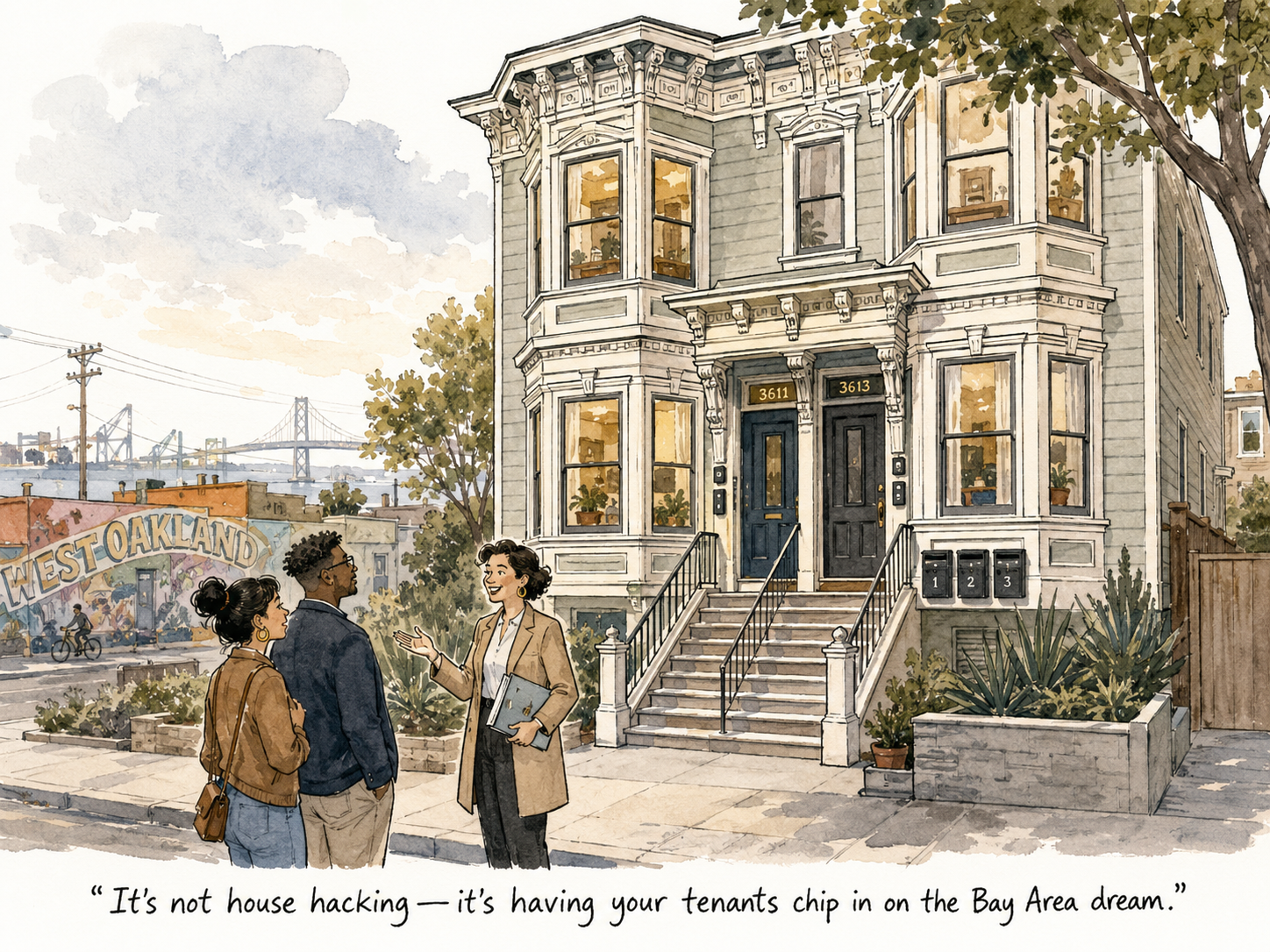
None of that changes my opinion on the strategy itself. House hacking is still one of the best ways I know for a first-time buyer to build real wealth, get their foot in the door of Bay Area real estate, and avoid becoming house poor the way a lot of solo single-family buyers do here. And there's a bonus most people don't talk about: the East Bay has some genuinely unique, beautiful old architecture — Craftsman duplexes, converted Victorians, classic California fourplexes — that make for incredible house hack setups when it's done correctly. You get to actually live in and improve a piece of property that's yours, not a landlord's. Pride of ownership is real, and it hits different when you're building your own equity instead of paying down someone else's mortgage.
Being a landlord in the Bay Area isn't always sunshine and rainbows
This is where local knowledge really matters, and it's exactly the kind of detail that trips up buyers who read generic house-hacking advice written for other markets. Don't assume owner-occupancy automatically gets you out of rent control — in the East Bay, it usually doesn't.
In Oakland, owner-occupied duplexes and triplexes are NOT exempt from rent control. This wasn't always true — there used to be an owner-occupant exemption — but Oakland City Council eliminated it back in 2019, following voter approval of Measure Y. Today, if you buy a duplex or triplex in Oakland and rent out the other unit(s), those units are fully subject to Oakland's Rent Adjustment Program, meaning your ability to raise rent is capped, and you're also subject to Oakland's Just Cause for Eviction protections. This doesn't make house hacking a bad idea in Oakland — it just means you need to underwrite the deal assuming controlled, modest rent increases over time, not market-rate flexibility.
Berkeley isn't the easy out it might seem like, either. Berkeley's rent stabilization ordinance does technically have an owner-occupied duplex exemption on the books, sometimes called the "Golden Duplex" rule — but it only applies to units where the owner has continuously occupied one side since December 1979. In practice, that's a legacy carve-out for a small, shrinking number of longtime owners, not something a first-time buyer purchasing a duplex today can use. If you buy a Berkeley duplex now and rent out the second unit, that unit is subject to Berkeley's rent stabilization ordinance just like most of the city's rental stock — and there's been ongoing pressure at the city level to eliminate the Golden Duplex exemption entirely.
The real takeaway: in both Oakland and Berkeley, a first-time buyer today should plan on rent control applying to the unit(s) they rent out, not go in assuming owner-occupancy is a loophole. Before you fall in love with a specific property, it's worth understanding exactly which local ordinance applies to it — the rules can vary not just city to city, but sometimes based on the property's construction date and unit count too.
Where to be honest with yourself
I'd be doing you a disservice if I didn't mention the trade-offs. You'll be a landlord, which means dealing with maintenance requests, tenant screening, occasional vacancies, and — as covered above — navigating rent control compliance correctly.
And if it ever does go sideways with a tenant, remember that the courts control the clock, not you. Evicting a non-paying or lease-violating tenant in California goes through the judicial unlawful detainer process — it's not something you can handle informally, and you can't just change the locks. An uncontested case can move in as little as 40-60 days, but if a tenant contests it, raises a defense, or you land on a backed-up court calendar, that timeline stretches out fast. Realistically, plan for 60-90+ days in a contested case, and in a genuine worst-case scenario, four to six months or more with a non-paying tenant still in the unit while it works through the system. That's a real cash-flow risk worth budgeting a reserve for, not just a rare exception.
Multifamily properties can also see more deferred maintenance than single-family homes, since prior owners were sometimes investors who didn't live on-site. And living next to or above your tenants isn't for everyone; some people love the built-in community, others find it intrusive.
None of these are dealbreakers, but they're worth an honest conversation before you commit — ideally with someone who can walk the property with you and help you actually run the numbers on rent, expenses, and financing side by side.
Questions I hear most often from first-time buyers
Do I have to live in the property forever to keep these loan terms? No, but lenders typically require you to occupy the property as your primary residence for at least one year after closing. After that, you're generally free to move out and rent your unit too, refinance, or sell — though it's worth discussing the specifics with your lender before you buy, since terms can vary.
Is a 2-unit property treated differently than a 3- or 4-unit property? For financing purposes, all four categories (1-4 units) can qualify for owner-occupant loans, but the paperwork and underwriting get more detailed as you add units — more leases to review, more rental income to document, and for FHA loans, historically stricter cash-reserve requirements on 3-4 unit properties. It's manageable, but it helps to work with a lender who handles multifamily owner-occupant loans regularly rather than one who mostly does standard single-family purchases.
What if I can't find a multifamily property in the exact neighborhood I want? This is a real constraint — multifamily inventory is concentrated in certain pockets of Oakland and the East Bay rather than spread evenly across every neighborhood. It's worth being flexible about the specific streets you're looking at and focusing more on the fundamentals: unit condition, rental comps, and how the numbers work, rather than chasing one exact block.
Does this only work in Oakland? Not at all — this strategy applies across the Bay Area wherever multifamily inventory exists, from the East Bay down through the South Bay and up the Peninsula. Oakland and Berkeley just happen to have a meaningful concentration of older duplexes and triplexes, plus their own specific (and sometimes confusing) rent control rules, which is why I'm using them as the example here.
The bottom line
For a lot of first-time buyers, the Bay Area feels like it's simply out of reach on a single income and a single unit. Multifamily house hacking flips that equation: instead of trying to afford the whole property yourself, you're sharing the cost with tenants from day one, using leverage to control a larger, appreciating asset, and unlocking tax advantages like depreciation that single-family homeownership just doesn't offer — all while building equity in one of the most consistently appreciating housing markets in the country. With down payment requirements dropping and financing rules loosening up over the past year, owner-occupied multifamily investing is more accessible than it's been in a long time — you just need to go in with clear eyes about the city-specific rules, especially around rent control, that will shape your cash flow and numbers for years to come.
Check out this article next

Leave a Reply